
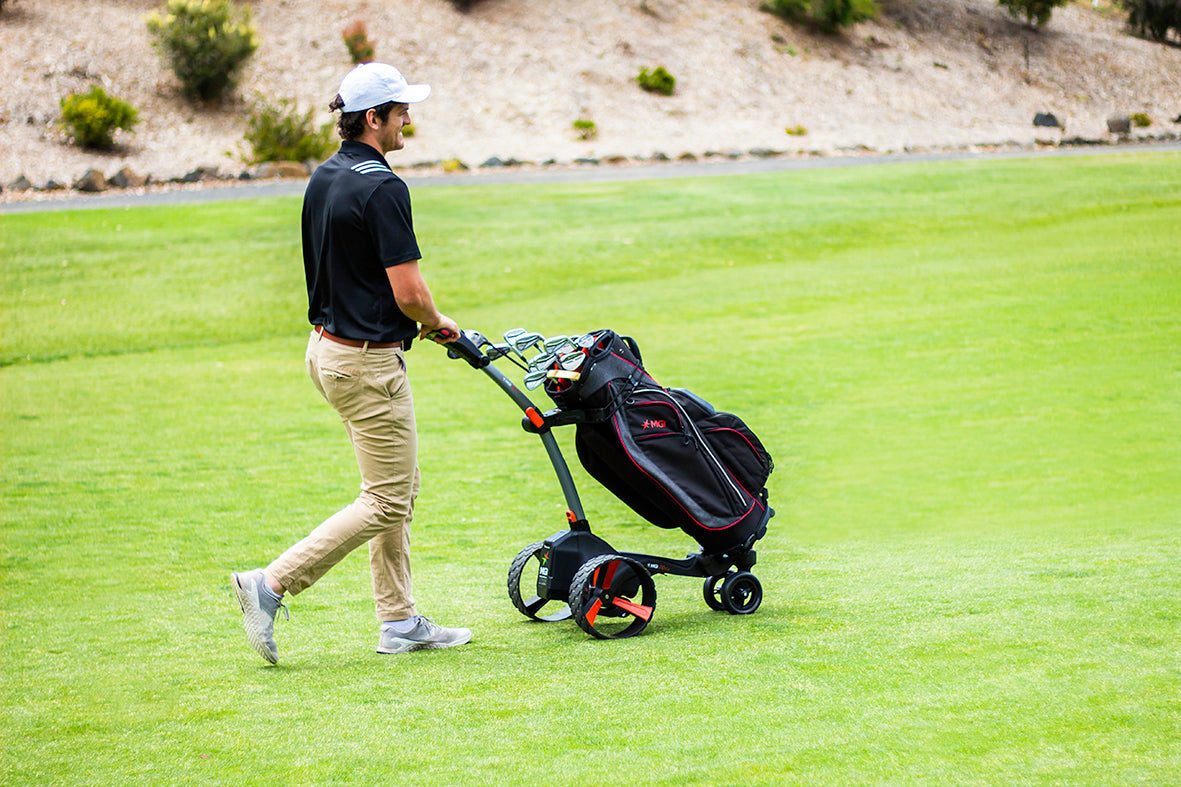
Walking 18 holes covers 4 to 6 miles and often well over 10,000 steps. Research links it to better heart health, nearly double the calories of riding, and in some studies better scores. The catch is the bag. Below is what the research says, with calorie numbers for 9 and 18 holes, and how an electric caddy lets you keep walking without the strain.
Key takeaways
|
|
|
|
|
How far do you walk in a round of golf?
A walked 18-hole round covers about 4 to 6 miles (6–10 km), depending on course length and how much you zigzag between shots. Nine holes is roughly half that.
In a 2025 study published in the European Journal of Sport Science, golfers who walked averaged 17,007 steps per 18 holes. The same golfers took 6,274 steps when riding a cart.
|
Round |
Walking |
Riding a cart |
|---|---|---|
|
18 holes, distance |
4–6 miles |
A fraction of that; most of the distance is driven |
|
18 holes, steps |
~17,000 (2025 study) |
~6,300 (2025 study) |
|
9 holes, steps |
about half of 18 |
about half of 18 |
What are the health benefits of walking the golf course?
1. You move a lot more than you think
Researchers at Liverpool John Moores University tracked 16 competitive golfers over tournament rounds. Walking, they averaged 17,007 steps and 880 kcal. Riding, it was 6,274 steps and 456 kcal.
The PGA of America puts a typical walked 18 at up to four miles and 10,000+ steps. That’s a full day’s step goal before you reach the 19th hole.
2. It’s good for your heart
In a Finnish study of 25 golfers aged 65+, an 18-hole walk lowered blood pressure, blood sugar, and cholesterol. The researchers found it may be slightly better for cardiovascular health than an hour of brisk or Nordic walking.
3. It’s low-impact exercise you’ll actually keep doing
Walking golf is low-to-moderate intensity. You get four hours of exercise without it feeling like a workout, and you can keep doing it for decades.
4. It’s good for your head
Fresh air, green space, and four hours with your playing partners. Walking keeps the group together between shots, which is where the conversation happens and where you can shake off a bad hole before the next one.
How many calories do you burn playing golf?
Most golfers burn roughly 400 to 900+ calories per round. The range depends on whether you walk or ride, whether you carry your bag, and how many holes you play.
Calories burned in 9 holes of golf
In a 2008 study of 9-hole rounds, walking burned about 720 calories and riding burned 411.
|
How you play 9 holes |
Calories burned |
What it means |
|---|---|---|
|
Walking + carrying your bag |
721 kcal |
Most calories, most strain on your back |
|
Walking + push cart |
718 kcal |
Same burn as carrying, far less strain |
|
Walking, caddie carries the bag |
613 kcal |
Bag weight removed. Closest proxy for walking with an electric caddy |
|
Riding in a golf cart |
411 kcal |
~300 fewer calories than walking |
Calories burned in 18 holes: walking vs. riding
In the 2025 study, golfers burned about 880 calories walking 18 holes and about 456 riding, nearly double.
|
18 holes (2025 study) |
Steps |
Calories |
|---|---|---|
|
Walking |
17,007 |
~880 |
|
Riding a cart |
6,274 |
~456 |
Newer data backs this up. A 2022 study of aspiring professionals found no meaningful difference in energy burned between carrying and using a trolley, but the golfers who carried felt they were working hardest. The researchers called this important for recreational golfers who want golf’s health benefits but find carrying uncomfortable.
Does walking make you a better golfer?
Often, yes, as long as you’re not carrying the bag. In Wolkodoff’s 2022 field study, golfers who walked with an electric trolley posted the best mental-focus rating (6.63 vs. 5.67 push cart, 5.01 riding) and the lowest nine-hole scores (+10.2 vs. +10.4 push cart, +11.5 riding).
Golf Digest ran its own 20-round test: 10 rounds carrying and 10 walking with an MGI Zip Navigator. Front-nine scores were about the same. On the back nine, the writer averaged 41.6 with the MGI vs. 43.9 carrying, and double bogeys on the last three holes dropped from 10 to 2.
Walking also keeps you tuned in to the course: wind, slopes, green firmness, and yardages you’d miss from a cart.
There's also a feel benefit. On foot, you notice the slope of the fairway, the firmness of the turf and how the wind moves through the trees. That's information you miss riding from cart path to cart path, and it feeds directly into club selection and reads.
Why more avid golfers are walking
Serious golfers are choosing to walk more, and not only for the exercise. Walking slows the round down to the pace of the game. You arrive at your ball having already looked at the shot, and you play with more presence and less rush.
But walking 18 holes is physically demanding, especially for golfers who play several times a week. Fatigue shows up on the back nine as a loss of focus, not just tired legs. For golfers who want to walk for years, the real question isn't whether to walk. It's how to make walking sustainable. That usually comes down to what's carrying the bag.
The downside of walking: carrying the bag
Walking isn’t what hurts. Carrying is. The Titleist Performance Institute notes that a bag can be lifted 100+ times a round, putting compressive and twisting load on the spine and raising injury risk to the shoulders, back, and ankles. Pull carts twist the spine too. TPI’s recommendation: push, and consider a motorized cart for seniors and hilly courses.
The problem compounds for frequent players. Carrying, or even pushing a heavy cart up hills, several times a week adds up to repetitive strain on the back, shoulders and knees. That's often what forces regular walkers back into a riding cart.
Over a 4–5 hour round, that load adds up. It shows up as fatigue on the back nine, loose swings, and blow-up holes when it counts.
Carry vs. push cart vs. electric caddy vs. riding
|
Carry |
Push cart |
Electric caddy |
Power-assisted (E-BOOST) |
Riding cart |
|
|---|---|---|---|---|---|
|
Steps / exercise |
High |
High |
High |
Full walking workout. You push; the motor helps on demand. |
Low |
|
Strain on back & shoulders |
High |
Moderate |
Minimal |
Low. The boost takes the load on climbs. |
Minimal |
|
Back-nine fatigue |
High |
Moderate |
Low |
Lower than a manual push cart |
Low |
|
Focus & scoring (studies above) |
Worst late in round |
Good |
Best |
Not studied separately |
Worst |
|
Hills & long courses |
Hard |
Hard |
Easy |
Good. Press for a boost on hills. |
Easy |
|
Best for |
Young, fit, short courses |
Flat courses, budget |
Anyone who wants to walk every round |
Walkers who like to push but want help on hills or late in the round |
When walking isn’t an option |

How to choose a walking golf cart
If you want to keep walking without carrying, a walking golf cart takes the bag off your shoulders. There are three main types:
|
|
|
For more detail, see The Ultimate Walking Golf Cart or compare MGI models.
Other benefits of walking the course
|
|
|
How an MGI electric caddy helps you walk every round
An electric golf caddy carries your bag under its own power while you walk. You get the steps, calories, and focus of walking without the load on your back. Pick the model that fits the way you play:
MGI E-BOOST
What it is: a lightweight push cart with a built-in boost motor. You push; the motor helps on hills.
Best for: golfers who like pushing but want help on the climbs.
MGI Zip Navigator
What it is: a remote-control electric caddy. Send it ahead, walk hands-free.
Best for: walkers who want zero load on the body. It’s the caddy used in Golf Digest’s scoring test.
MGI Zip Navigator AT
What it is: the all-terrain Zip Navigator, built for steep, rough, off-path ground.
Best for: hilly courses and tough terrain.
MGI Ai Navigator Halo
What it is: MGI’s flagship AI-powered caddy with GPS and Geo Protect navigation.
Best for: golfers who want the most advanced hands-free walking experience.
Not sure which fits? Compare MGI caddy models or read What Is an Electric Golf Caddy?.
FAQ: Walking the golf course
Is walking 18 holes of golf good exercise?
Yes. A walked round covers roughly 4–6 miles and often more than 10,000 steps. One 2025 study measured about 17,000 steps and 880 calories per walked tournament round. It counts as low-to-moderate intensity exercise.
How many calories do you burn walking 9 or 18 holes?
Wolkodoff’s study measured about 720 calories for nine holes walked (carrying or pushing) vs. about 410 riding. Over 18 holes, walking golfers in a 2025 study burned about 880 kcal vs. 456 riding. Actual numbers vary with body weight, terrain, and pace.
Is it better to carry your golf bag or use a push cart?
Calorie burn is nearly identical, but carrying puts much more strain on your spine and shoulders, and carrying golfers report feeling more tired. A push cart or electric caddy gives you the same exercise with far less wear.
Do you still get exercise with an electric golf caddy?
Yes. You still walk every step. The caddy takes the bag’s weight, not the walking. Golfers using electric trolleys in a 2022 study still met moderate-intensity exercise levels.
Does walking improve your golf score?
It can, when you’re not carrying the bag. Studies and Golf Digest’s own test found walking with a trolley or remote caddy produced better focus and fewer blow-up holes late in the round than carrying or riding.
Is an electric golf caddy good for seniors or golfers with back issues?
It’s one of the best ways for seniors to keep walking. The Titleist Performance Institute recommends motorized carts for senior golfers and hilly courses because they remove the bag’s load. If you have a medical condition, check with your doctor first.
Walk more. Carry nothing.
The benefits of walking the golf course are real, and they’re easier to get when you’re not hauling the bag. Shop MGI electric caddies or see the E-BOOST push cart.


