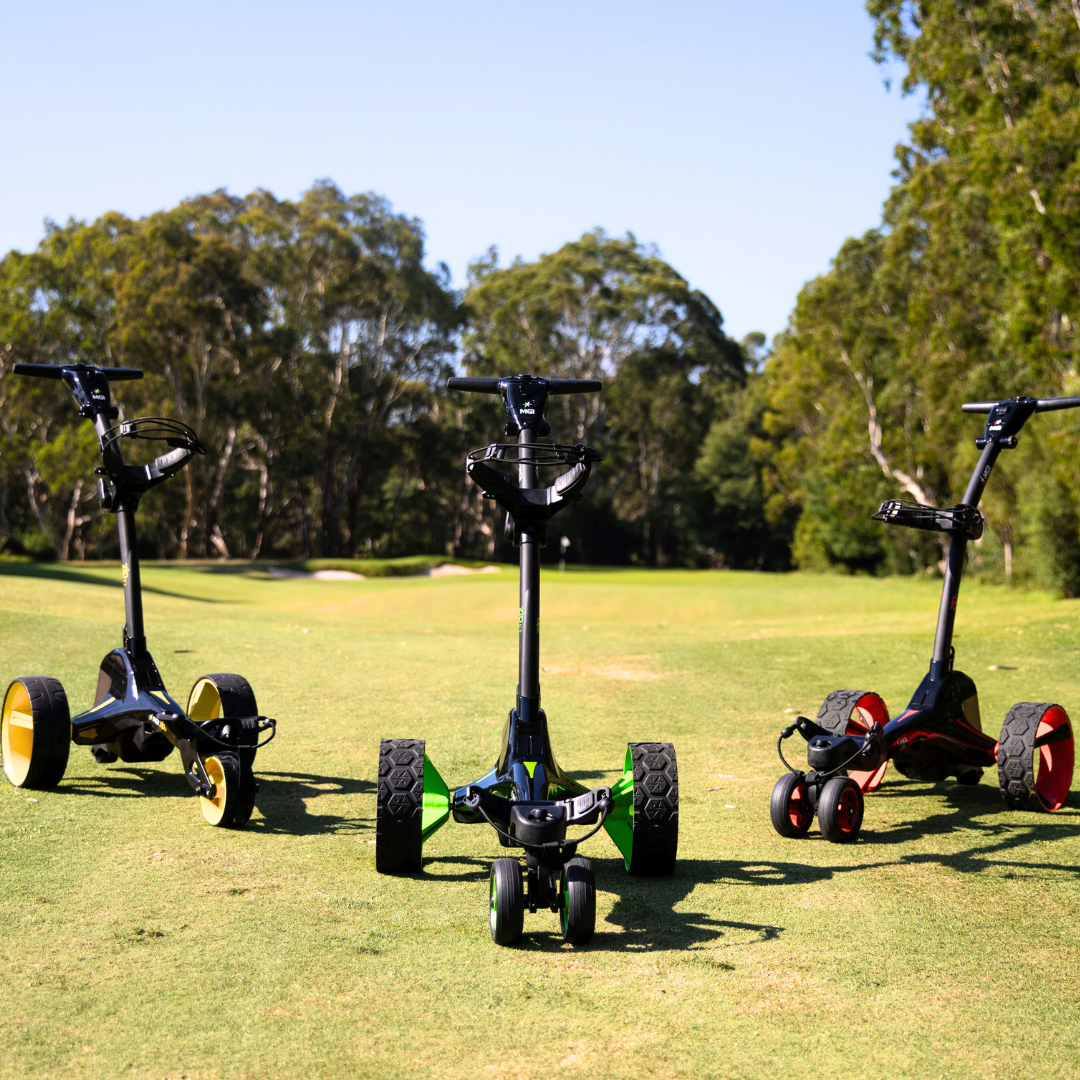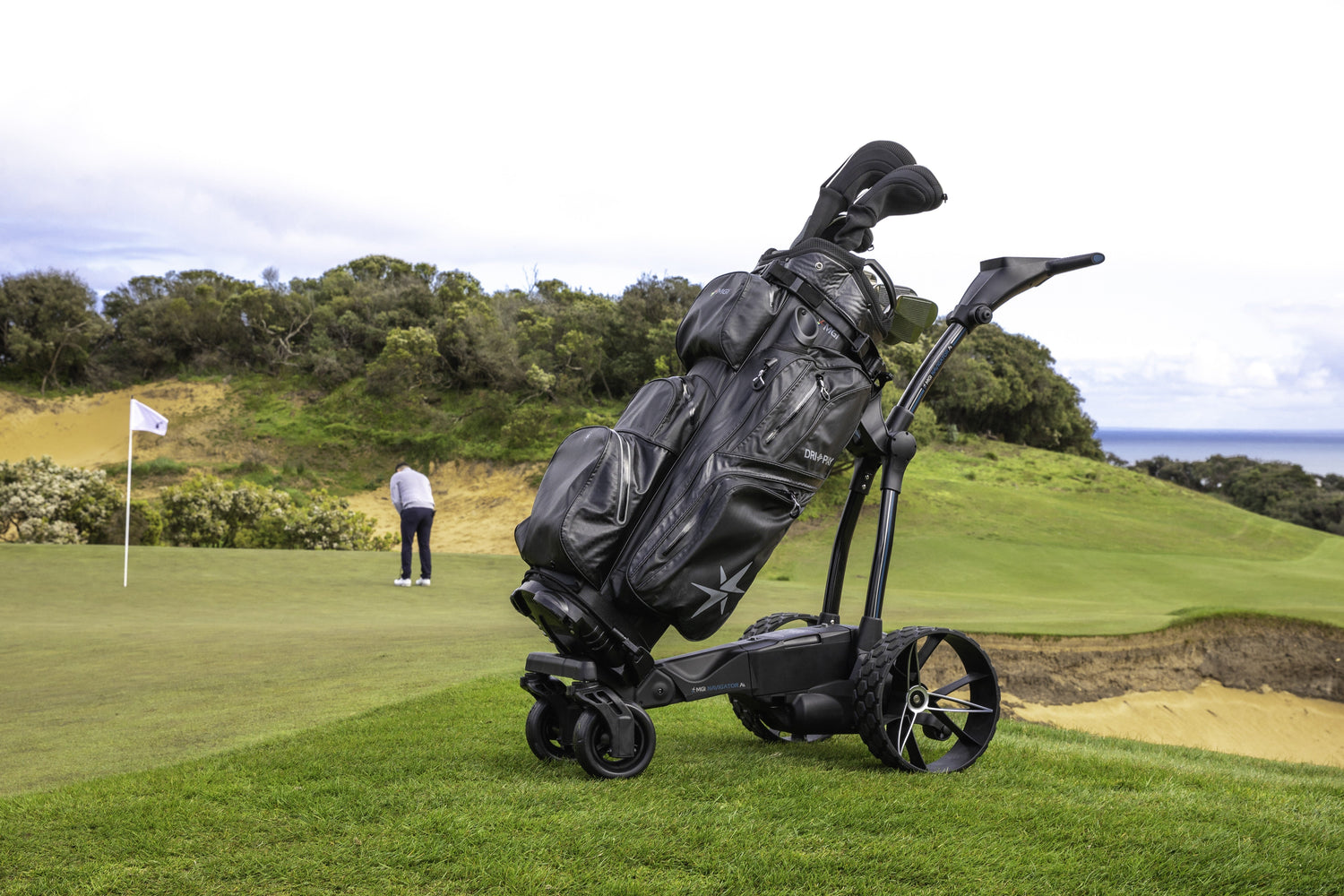
Most golfers already have a way to measure yardage.
Maybe it's a GPS watch. Maybe it's a phone app. Maybe it's the rangefinder clipped to the side of the bag that comes out before every approach shot. So when you're shopping for a golf push cart GPS system and see built-in GPS listed as a headline feature, the natural question is a fair one:
Do I actually need that?
The answer depends entirely on how you play. For some golfers, an electric caddy with GPS would simply duplicate information they already have. For others, it changes the way they move through the course, manage a round, and think about strategy from the first tee to the final putt.
That's why this conversation has become more interesting over the last few years. The biggest development isn't simply that some carts now have GPS. It's what happens when GPS becomes part of a larger system that combines course maps, distance information, hazard awareness, and laser-precise measurements into one place.
The goal of this article is to explain what cart GPS actually does, who benefits from it, and what options exist today so you can decide whether it's something you'll genuinely use or something you'll never think about after the first round.
What "Cart GPS" Actually Means — and What It Doesn't
Before deciding whether GPS matters, it's important to understand what we're actually talking about. A GPS-enabled electric golf caddy contains a built-in GPS receiver connected to a database of mapped golf courses. It displays information directly on the caddy, giving golfers access to hole layouts, front-center-back yardages, and hazard locations without relying on a separate device.
The MGI Ai Navigator Halo takes this approach with more than 40,000 course maps displayed through a 4-inch all-weather touchscreen. Everything lives directly on the caddy, with no phone required to access course information.
Just as importantly, GPS is not several other things golfers often confuse it with.
First, GPS is not a laser rangefinder. GPS provides distances to predetermined points on the golf course, such as the center of the green or the front edge of a bunker. A laser rangefinder measures the exact distance to whatever you aim at, whether that's the flagstick, a tree, or a carry distance over water.
Second, GPS is not navigation.
Knowing where the hazard is and knowing where the caddy should go are two very different things. We'll come back to that distinction later because it is one of the most important developments in walking golf technology today.
Generally speaking, golfers have three GPS configurations available:
- Built-In GPS: The GPS system is integrated directly into the caddy. The Ai Navigator Halo falls into this category.
- Device-Assisted GPS: The caddy includes a holder or mount for a phone, GPS device, or watch companion app. The Zip Navigator supports this approach.
- Independent GPS: The golfer uses a watch, phone, or rangefinder completely separate from the caddy. Both the Zip Navigator and E-BOOST can be used this way.
None of these approaches are inherently better. The right choice depends entirely on how you prefer to get information during a round.
Do You Actually Need GPS on Your Cart?
Not every golfer does. In fact, many golfers are perfectly served by the devices they already use. You probably don't need GPS built into your caddy if:
- You already wear a GPS watch and check it before every shot.
- You play the same few courses repeatedly and know most yardages by memory.
- You rely primarily on a laser rangefinder for distance information.
- You're shopping with budget as your top priority.
- You prefer a simpler experience with fewer screens and features.
For those golfers, the comparison is often less about GPS and more about GPS golf cart vs rangefinder. If a rangefinder already gives you the information you trust, adding another screen may not change much.
On the other hand, there are situations where GPS genuinely changes the experience. Golfers who play a variety of courses often benefit from seeing hole layouts and hazard positions before reaching them. GPS provides context that a rangefinder cannot.
Golfers who prefer to travel light may appreciate replacing multiple devices with one integrated system. And golfers interested in AI-assisted navigation features like Geo Protect need GPS because those systems rely on course mapping to function.
The most compelling setup may actually be the combination of GPS and laser technology working together. GPS provides course awareness and strategic context. A rangefinder provides exact distances. Together, they create a more complete picture than either can provide independently.
GPS on the Cart vs. GPS for the Cart: The Geo Protect Distinction
This is where the conversation gets really interesting, and most stop at the idea that GPS shows you a yardage. The reality is that GPS can do much more than display information. On most products in the market, GPS exists for the golfer. It shows distances, displays hole layouts, and helps with course management.
The golfer interprets the information, and the caddy itself does nothing with it. However, the Ai Navigator Halo takes a different approach. Its GPS system informs both the golfer and the caddy.
Geo Protect, MGI's AI-powered hazard navigation system, relies on GPS mapping to function. The caddy knows where hazards exist because the GPS system provides that information. Without GPS, a remote-controlled electric golf caddy can only drive, track straight, and respond to commands. It has no understanding of where bunkers, water hazards, or restricted areas exist.
With GPS powering Geo Protect, the Halo gains awareness of the course itself. That allows it to slow near hazards, stop before danger areas, and adjust movement around mapped no-go zones.
The MGI GPS Options: What You Actually Get at Each Level
No GPS on the Caddy
- MGI Zip Navigator
- MGI E-BOOST
Neither the Zip Navigator nor the E-BOOST includes integrated GPS. For many golfers, that's perfectly fine. The Zip Navigator includes a GPS holder that allows golfers to mount a phone or separate GPS device if desired. The E-BOOST takes an even simpler approach, focusing entirely on walking assistance.
These options work best for golfers who already own a GPS watch, use a trusted golf app, or prefer laser rangefinders for distance information. Add a SureShot rangefinder and you have precise yardage measurements without paying for a built-in GPS system you may never use.
Integrated GPS and Rangefinder Pairing
MGI Ai Navigator Halo + SureShot SlimPRO
This is where things become unique. The Halo's integrated GPS system provides access to more than 40,000 course maps through its onboard touchscreen.
The standout feature is the pairing between the Halo and the MGI SureShot SlimPRO Laser Rangefinder. Through Bluetooth integration, precise distance measurements from the rangefinder appear directly on the Halo's touchscreen.
The result combines:
- GPS course maps
- Hazard locations
- Hole layouts
- Front-center-back yardages
- Laser-precise pin distances
- Geo Protect AI navigation
Instead of juggling separate devices, the golfer gets course awareness and shot-specific precision in a single place.
Standalone Rangefinder
For golfers who simply want laser precision, a standalone rangefinder remains an excellent option. The SureShot PINLOC lineup offers several choices depending on budget and feature preferences.
The 7000iPSM includes slope-adjusted distances, vibration confirmation, scan mode, and magnetic mounting capability. The 7000iPM provides slope-adjusted distances and vibration confirmation. The 7000iM removes slope functionality for tournament-legal play.
The SlimPRO adds Bluetooth pairing capability with the Ai Navigator Halo while maintaining premium laser rangefinder functionality. For golfers focused on exact yardages rather than course mapping, this remains one of the simplest and most effective solutions available.
GPS Accuracy: Cart GPS vs Laser Rangefinder vs Watch
One of the most common questions golfers ask is whether GPS is accurate enough to replace a rangefinder. The answer is no, but that's not really the point. A laser rangefinder is the most precise distance tool available. Most models provide measurements accurate within a yard of the target.
GPS systems generally provide distances accurate within three to five yards depending on satellite conditions and course mapping. That sounds like a significant difference until you consider what each technology is trying to accomplish.
GPS provides continuous awareness. It's always available and requires no action from the golfer. A rangefinder provides precision. It tells you exactly how far away a specific target is at a specific moment.
They solve different problems, and that's why the strongest setup combines both. GPS gives context, while the laser provides certainty.
What to Look For in a GPS Push Cart
If you're considering a GPS-equipped electric golf caddy, there are a few questions worth asking before you buy.
Screen Quality
Can you actually read the display in direct sunlight? Outdoor visibility matters more than most golfers realize.
Course Database
How many courses are included? Golfers who travel frequently benefit from larger databases and broader coverage.
Phone Dependency
Does the GPS work independently, or does it require a connected phone and app?
Rangefinder Compatibility
Can the GPS system integrate with a laser rangefinder, or are they completely separate devices?
Beyond Distances
Does the GPS system power additional functionality?
For most products, GPS simply displays information. For the Ai Navigator Halo, GPS also enables Geo Protect navigation, making it part of how the caddy operates rather than simply what it displays.
Frequently Asked Questions
Do golf push carts come with GPS?
Most electric golf push carts do not include built-in GPS. The majority of remote-controlled electric caddies at mid-range price points have a GPS holder or mount so you can attach your own device. The MGI Ai Navigator Halo is one of the few electric push carts with fully integrated GPS — a 4" touchscreen connected to a database of 40,000+ courses, operating without a phone or external device.
What is the difference between cart GPS and a golf rangefinder?
Cart GPS shows pre-mapped distances to fixed points — front, center, and back of the green, plus course layout and hazards — from a screen on the cart. A laser rangefinder measures the precise distance to whatever you aim at, including the pin, a bunker face, or any target on the course. GPS is passive and always available; a rangefinder requires you to aim and measure. The best GPS push cart setups, like the MGI Halo paired with the SureShot SlimPRO, combine both so course-level GPS data and laser-precise shot distances appear on the same screen.
Can I add GPS to an electric golf push cart?
Yes. Most electric caddies include a GPS holder or accessory mount so you can attach a phone, GPS watch, or standalone GPS device. For laser precision, a rangefinder like the MGI SureShot PINLOC range attaches to any cart. The MGI Ai Navigator Halo is the only cart that integrates with the SureShot SlimPRO to display rangefinder measurements directly on the cart's built-in touchscreen.
Does a golf cart GPS work without a phone?
It depends on the cart. Many "GPS carts" rely on a paired phone for course data via a companion app. The MGI Ai Navigator Halo has GPS built into the cart itself — 40,000+ course maps are accessible on the onboard 4" touchscreen without a phone connection. The MGI SureShot app enhances functionality but is not required to use the GPS or course maps.
Is GPS accurate enough to replace a rangefinder on a golf cart?
For general course awareness — hole layout, distances to the green, hazard positions — cart GPS is accurate and reliable. For precise shot distances where ±1 yard matters, a laser rangefinder is more accurate than GPS. For most golfers, the ideal setup combines both: GPS for course management and hazard awareness, a laser rangefinder for shot-specific distance measurement.
What GPS push carts are available in 2026?
The MGI Ai Navigator Halo is one of the most capable GPS-equipped electric push carts available, combining integrated GPS with 40,000+ course maps, a 4" all-weather touchscreen, Geo Protect AI hazard navigation, and Bluetooth pairing with the SureShot SlimPRO laser rangefinder. Most other GPS carts in the category rely on a phone mount or companion app rather than a fully integrated onboard system.
The answer depends entirely on how you play. If you're perfectly happy with a GPS watch, a phone app, or a standalone rangefinder, you may never need GPS built into your electric golf caddy. Plenty of golfers get all the information they need from the devices they already trust.
For golfers who regularly play new courses, want course management information at a glance, or are interested in technology that actively enhances the walking experience, integrated GPS can become much more than a yardage tool.
If you want GPS course maps, laser-precise distances, and the added intelligence of Geo Protect hazard navigation, the MGI Ai Navigator Halo paired with the SureShot SlimPRO delivers one of the most advanced walking experiences available today. Together, they provide course awareness, strategic context, and precise shot information without requiring multiple devices or constant switching between screens.
If laser accuracy is your priority and you're happy with your current setup, the SureShot PINLOC 7000 Series remains an excellent option. You'll get precise distance measurements on any course, whether you're walking with an electric golf caddy, a push cart, or carrying your bag.
No matter which path you choose, the goal remains the same. Do whatever you can to spend less time managing equipment, and more time focused on playing your best golf.